New DOT Rule Changes How Airlines Classify Delays From 19 October 2026
A new federal rule takes effect next month that moves 10 types of flight disruption out of the airline-controllable bucket. Here is how it could affect meal vouchers, hotels and passenger rights.
Key Takeaways
- The final rule takes effect 19 October 2026 under Docket DOT-OST-2026-1257 (RIN 2105-AF29).
- It creates a new 'Section 511(b)' reporting category covering ten specific disruption types that must be excluded from the 'Air Carrier' category.
- Unscheduled maintenance that cannot be deferred, unruly-passenger removals and qualifying cybersecurity attacks all move out of the controllable bucket.
- DOT states the total value of amenities and compensation provided to consumers will be reduced, but says the magnitude cannot be reliably estimated.
- Rebooking obligations and existing refund regulations are unchanged — this rule governs delay-cause reporting, not refunds.

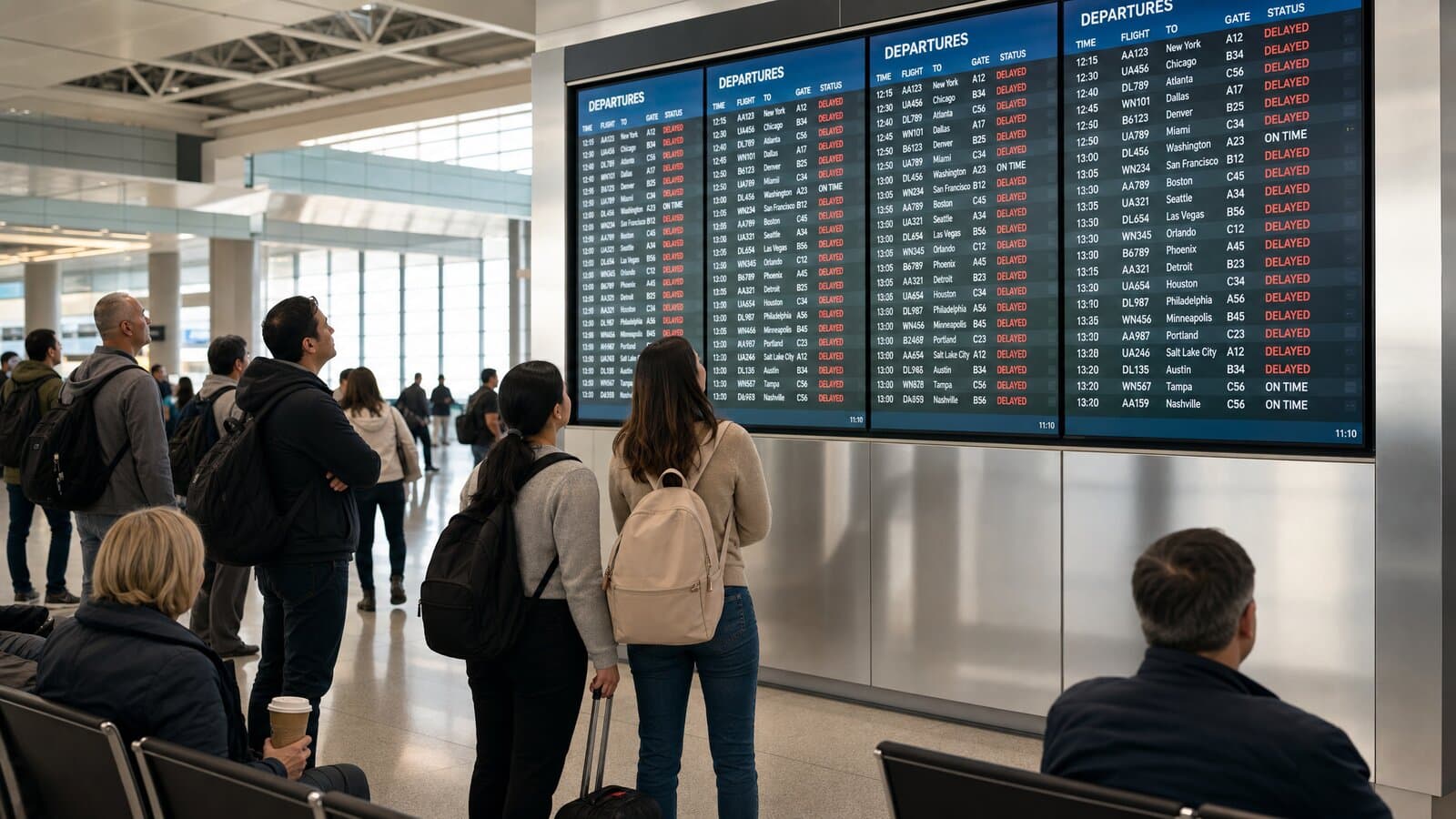
## What Changes on 19 October
The US Department of Transportation has finalised a rule that changes how airlines report the cause of flight delays and cancellations. Published in the Federal Register on 3 September 2026 under Docket DOT-OST-2026-1257 (RIN 2105-AF29), it takes effect on 19 October 2026.
The rule implements Section 511(b) of the FAA Reauthorization Act of 2024. It establishes six reporting categories for delays — Air Carrier, Extreme Weather, National Aviation System, Security, Late Arriving Aircraft, and a new Section 511(b) category — and five for cancellations. The new Section 511(b) category captures ten specific events that must now be excluded from the "Air Carrier" classification.
That exclusion is the whole story, because "Air Carrier" is the reporting label that underpins what the industry and the Department call a controllable delay or cancellation.
The Ten Reclassified Events
The final rule lists ten events that move into the Section 511(b) category:
1. Aircraft cleaning necessitated by the death of a passenger 2. Aircraft damage caused by extreme weather, foreign object debris, or sabotage 3. A baggage or cargo loading delay caused by an outage of a bag system not controlled by a carrier or its contractor 4. Cybersecurity attacks, provided the air carrier is in compliance with applicable cybersecurity regulations 5. A shutdown or system failure of government systems that directly affects the ability of an air carrier to safely conduct flights and is unexpected 6. Overheated brakes due to a safety incident resulting in the use of emergency procedures 7. Unscheduled maintenance, including in response to an airworthiness directive, manifesting outside a scheduled maintenance program that cannot be deferred or must be addressed before flight 8. An emergency that required medical attention through no fault of the carrier 9. The removal of an unruly passenger 10. An airport closure due to the presence of volcanic ash, wind, or wind shear
Item seven is the one that matters most in practice. Unscheduled maintenance is among the most common causes of significant delays, and until now a maintenance delay has been the clearest example of something within the airline's control.
Why This Affects Meal Vouchers and Hotels
Here is the mechanism, because it is easy to misread. The rule does not directly strip any passenger right. What it does is change a reporting category.
The connection runs through carriers' own customer service plans. As DOT notes in the rule, every reporting carrier that sells tickets currently commits, in its customer service plan, to providing amenities at no cost for lengthy controllable delays and controllable cancellations. Those commitments are legally enforceable once made — but they are pegged to the controllable definition. Shrink the set of disruptions classified as controllable, and the set of disruptions that trigger a free hotel room or meal voucher shrinks with it.
DOT is explicit about the consequence. The Department states that the total value of amenities and compensation currently provided by air carriers to consumers will be reduced under the final rule, while adding that the magnitude of that reduction cannot be reliably estimated.
What Does Not Change
Rebooking obligations are untouched. US carriers must still rebook passengers on their own flights at no additional cost following a cancellation or significant delay. The Department's existing automatic refund regulations also remain in force — this rule governs delay-cause reporting categories, not refund entitlements. If you decline the alternative offered after a cancellation or significant change, your refund rights are unaffected.
The distinction worth holding onto is this: rebooking and refunds are regulatory obligations; meals and hotels are contractual commitments in each carrier's customer service plan. This rule touches the trigger for the second category, not the first.
What to Do From Mid-October
Ask for the cause code. When a delay or cancellation happens, the official cause the airline records is now the single variable that determines whether amenities are owed, and it is worth asking the agent to state it. If the carrier cites one of the ten Section 511(b) events, that is why a voucher is not being offered.
Read your carrier's customer service plan before you travel. Carriers may revise these plans as the new categories take effect, and the plan — not the regulation — is what defines the amenities you can claim. Travel insurance and credit card travel protection become materially more relevant for exactly these scenarios.
### The Statutory Origin
Section 511(b) of the FAA Reauthorization Act of 2024 directed the Department to establish reporting categories distinguishing disruptions within a carrier's control from those outside it with greater precision than the existing five-category Bureau of Transportation Statistics framework allowed.
The pre-existing framework — Air Carrier, Extreme Weather, National Aviation System, Security, and Late Arriving Aircraft — treated the Air Carrier bucket as a residual: anything not attributable to weather, the NAS, security or a late inbound aircraft defaulted into it. That residual structure is precisely why unscheduled maintenance and unruly-passenger removals were classified as carrier-controllable, regardless of whether the carrier could realistically have prevented them.
The Compliance Condition on Cybersecurity
The cybersecurity carve-out is conditional rather than absolute. A carrier may only classify a cyber-attack-driven disruption under Section 511(b) if it is in compliance with applicable cybersecurity regulations at the time. A carrier operating outside those requirements cannot claim the exclusion, which preserves an incentive to maintain security posture rather than treating attacks as a blanket exemption.
Reporting Mechanics
The change flows through the Bureau of Transportation Statistics on-time performance filings that reporting carriers submit monthly. Analysts and passengers who track carrier reliability should expect a visible discontinuity in the Air Carrier delay series beginning with October 2026 data. Year-over-year comparisons of controllable delay rates that straddle the effective date will not be like-for-like, and any carrier showing a sharp improvement in controllable delay performance in the fourth quarter of 2026 should be read against this reclassification before it is read as an operational gain.
Associated Verified Change Records
SWISS Inaugurates New 'SWISS Senses' Cabin on First Delivered Airbus A350-900
Swiss International Air Lines took delivery of its first factory-fresh Airbus A350-900 featuring the all-new SWISS Senses cabin architecture, including private first-class suites and heated/cooled business seats.
Passengers booking SWISS between Zurich and Boston or New York-JFK on designated A350 flights will experience redesigned seats with customizable temperature control, wireless phone charging, and significantly quieter acoustic insulation.
Delta Completes Free Viasat Wi-Fi Rollout on 90% of Domestic Trunk Fleet
Delta Air Lines has activated fast, complimentary in-flight Wi-Fi for all SkyMiles loyalty members on over 650 mainline domestic narrowbody aircraft.
You no longer need to pay $5-$10 for Wi-Fi on Delta domestic flights. Create a free Delta SkyMiles account before boarding, connect to 'DeltaWiFi.com' in flight, and enter your credentials for unlimited high-speed streaming gate-to-gate.
Primary Sources & Sourcing Verification
Flight News Daily strictly enforces primary document verification. Every factual claim is corroborated against official filings, tariffs, or regulatory documents.
- Cause of Airline Delay and Cancellation Categories Under Section 511(b) of the FAA Reauthorization Act of 2024Published by U.S. Department of Transportation, Federal Register • Verified on 21 Sep 2026View Source
- DOT Final Rule Narrows Airline Delay and Cancellation Reporting Obligation Under FAA Reauthorization Act of 2024Published by Crowell & Moring LLP • Verified on 21 Sep 2026View Source
Related Airline Intelligence
American, United and Southwest Trim Flights as Jet Fuel Costs Surge
US carriers are cutting planned capacity after a sharp rise in jet fuel prices. Here is what the changes mean for travellers this autumn and into 2027.
Southwest Shifts to Assigned Seats: What Flyers Must Know
The biggest policy revolution in Southwest's 53-year history eliminates open seating. Here is the exact timeline and seat selection breakdown.
United Debuts Free Starlink Wi-Fi on First Mainline Aircraft
United Airlines has begun commercial passenger flights with SpaceX Starlink satellite Wi-Fi, offering sub-30ms latency and gate-to-gate speeds exceeding 250 Mbps.